
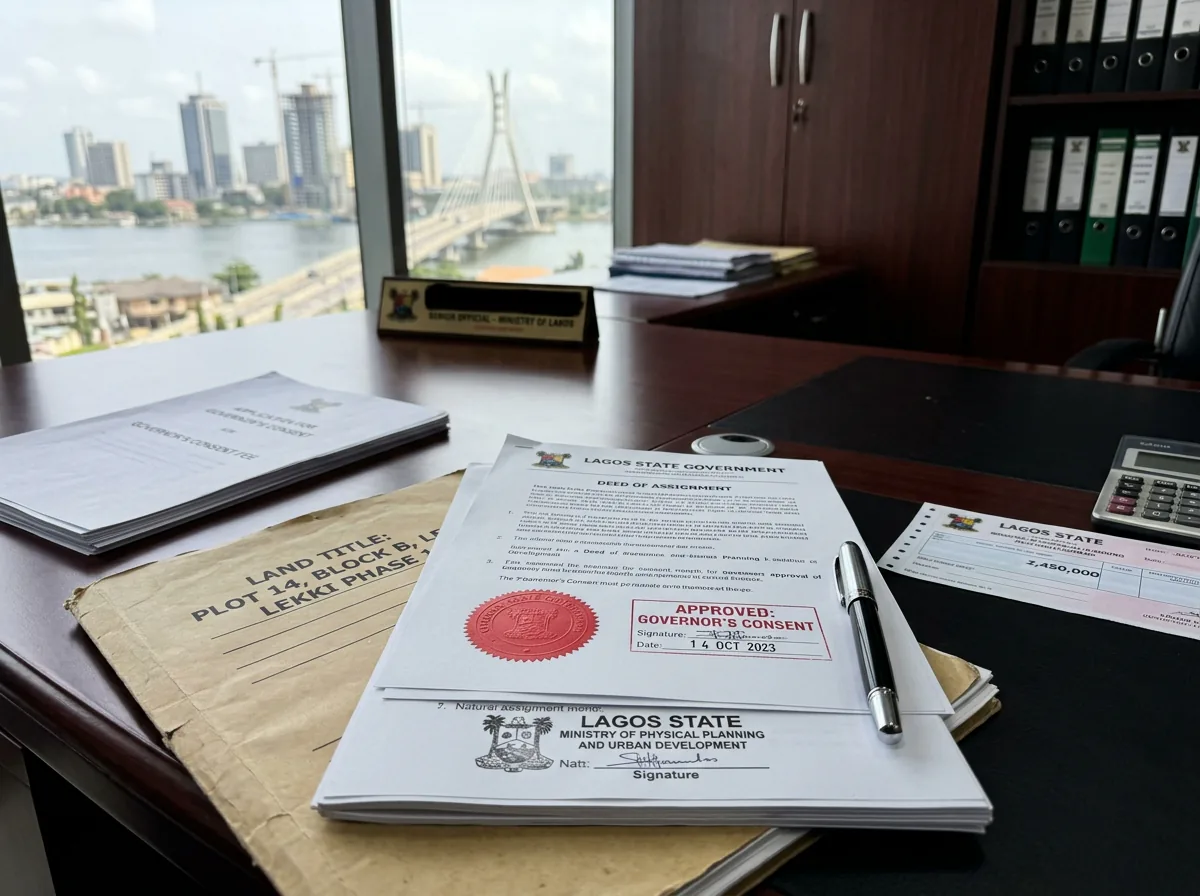
Governor's Consent is one of the most misunderstood elements of Lagos property transactions. Many buyers skip it to save money or because their agent told them it was not necessary. This is a mistake that can cost you your entire investment.
What Is Governor's Consent?
Under the Land Use Act of 1978, all land in Nigeria is held in trust by the state government. When a property with an existing Certificate of Occupancy (C of O) changes hands, the transfer requires the Governor's approval — known as Governor's Consent. Without it, the Deed of Assignment between buyer and seller is not legally perfected.
In simple terms: you can sign a deed, pay the full price, and move in but without Governor's Consent, your ownership is legally incomplete.
When Do You Need It?
You need Governor's Consent whenever you are buying a property that already has a C of O issued to someone else. This covers virtually all secondary market transactions in Lagos. Any property being resold by someone who is not the original government allottee.
You do not need it if you are the original allottee receiving a C of O directly from the government, or if the property is on land that does not have a C of O (though in that case, you have different documentation challenges).
What Does It Cost?
The cost of obtaining Governor's Consent in Lagos typically includes: consent fee (calculated as a percentage of the property value usually 1.5-3%), capital gains tax (payable by the seller but often negotiated), stamp duty (approximately 1.5%), registration fee, and legal/processing fees.
In total, expect to budget 3-6% of the property value for the full Governor's Consent process. This is a significant cost, which is why some buyers are tempted to skip it.
How Long Does It Take?
The standard processing time is 6-12 months, though it can be faster with experienced legal representation. The process involves application, assessment, payment, and final endorsement on the original C of O.
What Happens If You Skip It?
Without Governor's Consent, your Deed of Assignment is valid between you and the seller but it is not recognised by the government. This means you cannot use the property as collateral for a bank loan. If there is a dispute, your legal position is weaker. If the government decides to acquire the land, your claim is less protected. And when you eventually try to sell, your buyer will face the same issue but now two transfers need consent, making the process longer and more expensive.
Some buyers hold property without Governor's Consent for years without issues. But "no problem yet" is not the same as "no risk." It is gambling with your investment.
Our Recommendation
Budget for Governor's Consent from the start. Include it in your purchase cost calculations. Engage a solicitor experienced in the process. And do not let anyone tell you it is optional. It is the difference between a legally complete transaction and one that depends on nothing going wrong.
JESFEM includes Governor's Consent guidance and processing support in all our property transactions. We can estimate the total cost for any property before you commit.
